How to Price Notion Templates in 2026: Tiers, Positioning, and First Sales
Learn how to price Notion templates in 2026 using realistic tiers, buyer positioning, and bundle logic so your first template is easier to sell.
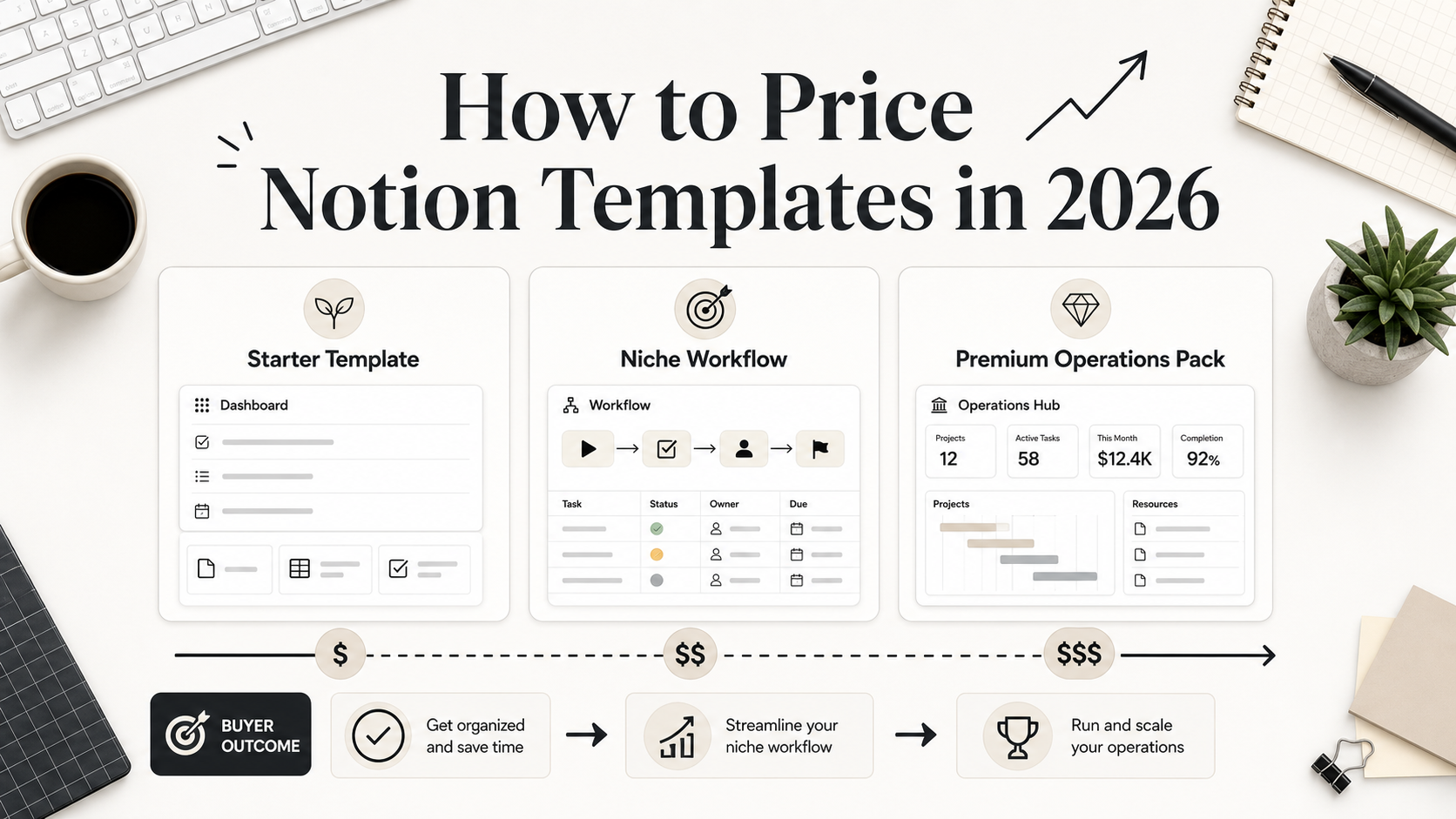
Visual summary: This summary image shows the three pricing levels that matter most for Notion sellers in 2026: entry template, niche workflow system, and premium business pack.
If you price a Notion template by page count, you usually undercharge. Buyers pay for a workflow outcome, cleaner setup, and time saved. The real pricing question is not “How big is it?” but “How directly does this help the buyer get a result?”
Quick Answer
The safest way to price Notion templates in 2026 is to use three tiers: entry template, niche workflow system, and premium business pack. Most first sellers should avoid racing to the bottom. A smaller template with a clear buyer outcome usually beats a giant dashboard, especially when you pair it with a clean product page and simple follow-up funnel.
Key Takeaways
- Price by buyer outcome, not by template size.
- Narrow workflow templates usually justify better pricing than broad dashboards.
- A good pricing ladder makes bundling and upsells easier after the first sale.
Decision Summary
- Choose this path if: you can describe one buyer problem and one specific transformation your template solves.
- Hold off if: your template is still a generic “second brain” with no buyer type or use case.
- Do next: publish one template at a clear tier, then test bundle and upsell logic after the first buyer response.
Why generic pricing advice fails
Many creators see template prices online and copy them without asking why those prices work. A USD 12 template and a USD 49 template can both be “Notion templates,” but they are not competing on the same basis. One may be a simple planner. The other may be a ready-to-run client workflow for a freelancer who bills real money.
That is why a “charge what others charge” rule is weak. The better rule is to match price to business value, buyer urgency, and setup friction. If the template helps a coach organize launches, an agency manage clients, or a creator ship content faster, the buyer is paying for a business shortcut, not just a pretty dashboard.
The three pricing tiers that make sense in 2026
1. Starter template
This is the entry-level offer: one clear use case, one clean system, and very little setup. Examples include a creator content calendar, a freelancer CRM-lite tracker, or a meal-planning template.
A starter template is best when:
- the buyer can understand it instantly
- the setup time is short
- the value is convenience, not deep customization
This tier works well as a first paid product or as the entry point into a later bundle.
2. Niche workflow system
This is where many serious first wins happen. A niche workflow system is not a generic dashboard. It is built for a defined buyer and outcome: client onboarding for freelance designers, a launch tracker for digital-product creators, or a simple editorial workflow for newsletter operators.
This middle tier usually carries the strongest mix of conversion and margin because the buyer sees more direct value without needing enterprise-level complexity.
3. Premium operations pack
This tier is for buyers who want several linked systems together: templates, SOP sections, onboarding flows, content trackers, or finance views. The price is higher because the buyer is not just getting pages. They are getting a stronger operating system that replaces hours of manual setup.
This tier only works if the positioning is sharp. A bloated life dashboard rarely deserves premium pricing. A business operations pack often can.
How to decide your first price
Ask four questions before publishing.
- What exact problem does the buyer solve with this?
- How expensive is that problem if they solve it badly?
- How long would it take them to build this themselves?
- How easy is the template to understand from screenshots alone?
If the answer to those questions is weak, lower the scope before you lower the price. A more focused template usually sells better than a cheaper but vague one.
What pricing mistakes slow first sales
The first mistake is underpricing a strong niche template because you assume new sellers must be cheap. Low prices can help with impulse purchases, but they can also signal low value, especially for business-use templates.
The second mistake is overpricing a broad template with no clear buyer. Buyers do not pay premium rates for “everything dashboards” unless the creator already has strong trust and a proven audience.
The third mistake is launching one price with no ladder. If you only have one product and one price, there is no natural upsell path. Even a simple free bonus, starter template, and larger bundle structure gives you more room to learn what buyers actually want.
A better launch structure than one lonely listing
The strongest pricing structure is usually not just a checkout page. It is:
- one focused template
- one simple product page with screenshots and outcome-based copy
- one free or low-friction lead magnet version
- one next-step offer or bundle
That is how pricing becomes part of a real money path instead of a guess. If the first buyer can become a bundle buyer, a waitlist subscriber, or a future workshop lead, the first sale is worth more than the product price alone.
Recommended Next Step
Do not price your first template like a commodity if it solves a business workflow. Put one clear price on one clear use case, then build the smallest product page and follow-up path that can turn a buyer into a second-step customer.
- Build the first product page and capture path in one stack: Try Systeme.io free
- Check the baseline before layering too many tools: Systeme.io Pricing in 2026
- If you want the fastest ready-made launch structure, go here next: Systeme.io Funnel Templates That Actually Convert
- Compare the creator launch tradeoff before you commit: Systeme.io vs Kit for Creator Launches in 2026
- Start from the broader template selling path here: How to Sell Notion Templates in 2026
- Get the free First Digital Product Follow-Up Path Checklist after the money path is clear: open the free checklist
Affiliate disclosure: Some recommendations may use affiliate links. If you sign up through them, we may earn a commission at no extra cost to you.
FAQ
What is a good starting price for a first Notion template?
A modest first price can work, but the better rule is to match the price to the clarity of the outcome. A narrowly useful business template usually deserves more than a generic personal dashboard.
Should creators bundle Notion templates early?
Yes, but only after one template proves that buyers understand the positioning. Bundle too early and you can hide the strongest use case inside a vague package.
Is it better to sell on Gumroad, Lemon Squeezy, or a funnel page?
All can work, but the strongest long-term setup is the one that lets you capture email, test copy, and move a buyer toward a second offer instead of a one-off transaction.